
Busted Mugshots KY serves as a central access point for Kentucky arrest records, inmate searches, and booking photographs from every county in the state. This portal aggregates data from multiple sources, including the Kentucky Arrests database, county-level booking logs, and the Kentucky Department of Corrections KOOL system. Recent entries show Macus McMillion from Harlan County with five public views, Kerohn Williams from Fayette County with two views, Jessica Frank and Hardin Jacob Stone each with one view, Richard Oldham from Perry County with two views, and additional detainees including Jacob Hulka from Jessamine County, Dwayne Hackney from Ohio County, and Anna Philp from Marion County. The system updates multiple times daily, pulling fresh booking data from sheriff’s offices across all 120 Kentucky counties.
Kentucky Arrests and Inmate Search Portal
The Kentucky Arrests and Inmate Search portal at kentucky.arrests.org displays the most recent bookings from every county in a single dashboard. Each entry shows the booking date, charge summary, and when available, a clickable mugshot link. The first page typically shows ten entries at a time, with pagination for older records. Recent entries include Macus McMillion from Harlan County, Kerohn Williams from Fayette County, Jessica Frank and Hardin Jacob Stone also from Fayette County, Richard Oldham from Perry County, Jacob Hulka from Jessamine County, Dwayne Hackney from Ohio County, Anna Philp from Marion County, James Jones, Hart Michael, and other detainees processed within the last 72 hours.
Kentucky Mugshots from BUSTEDNEWSPAPER.COM
BUSTEDNEWSPAPER.COM collects mugshots from every Kentucky county and presents them in a searchable format. The site tracks arrest statistics with precision, showing Allen County with 7,044 arrests in the last quarter, including 4,334 mugshots and 25,333 total case filings. Kenton County reports 51,649 total incidents with 18,092 photographed arrests. Other counties tracked include Knox with 18,092 arrests, Larue with 4,646, Laurel with 28,716, Leslie with 9,899, Letcher with 4,951, Lewis with 2,421, Lincoln with 7,837, Logan with 10,574, Madison with 29,612, Marion with 10,549, Mason with 9,939, McCracken with 26,706, Meade with 9,034, Montgomery with 14,021, and Muhlenberg with 9,617 arrests.
https://bustednewspaper.com/mugshots/kentucky/ 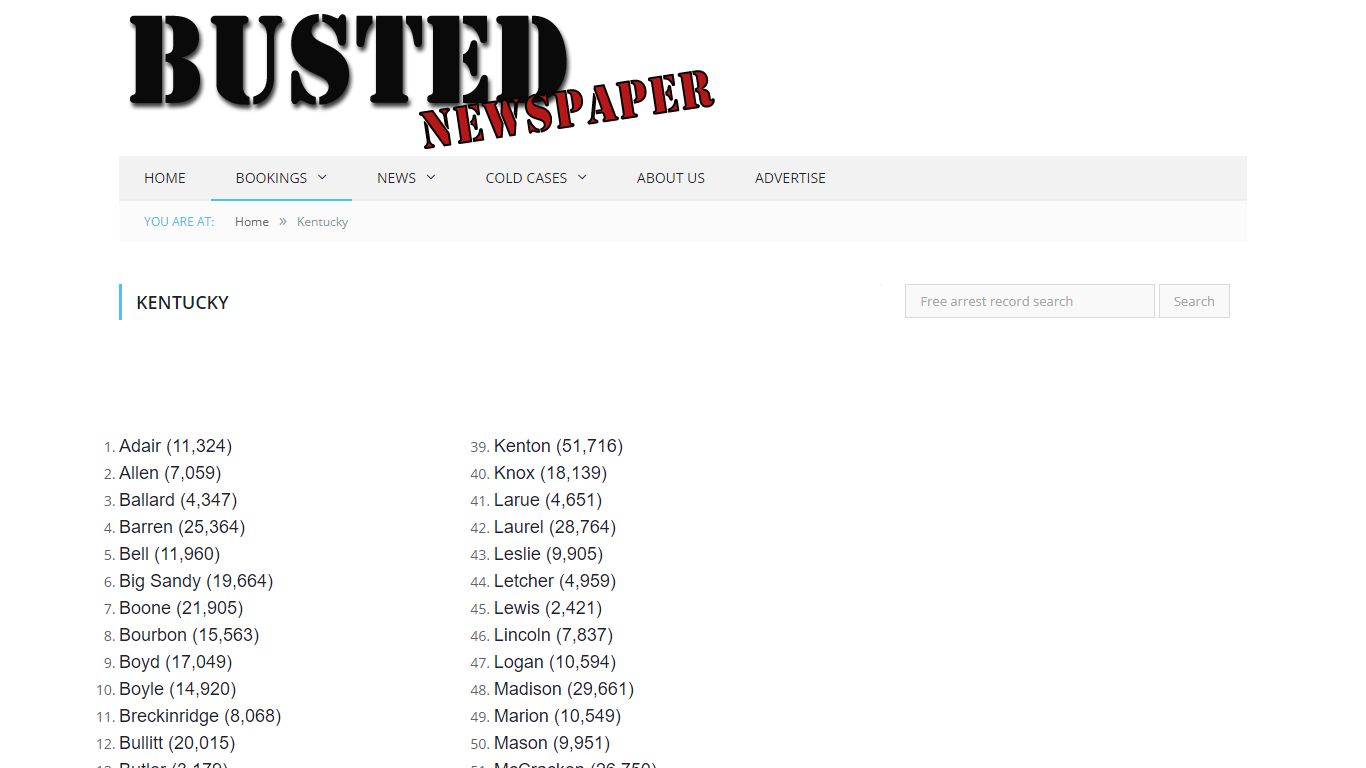
Pike County Arrest Activity and Search Data
Pike County’s arrest portal logged a notable traffic spike on October 22 at 08:51 AM, recording exactly 104 unique visitor views during that interval. The system displayed fresh booking entries covering offenses from traffic violations to felony charges. Each entry links to the county’s official detention roster, showing the individual’s name, booking date, charges, and bond amount. Pike County processes an average of 350 bookings per month, with the most common charges being possession of controlled substances, driving under the influence, and domestic violence offenses. The county updates its public arrest log every four hours during business days.
https://kentucky.arrests.org/index.php?county=696
Kentucky Offender Online Lookup System (KOOL)
The Kentucky Offender Online Lookup system, maintained by the Kentucky Department of Corrections, provides search access to individuals under state supervision. The KOOL portal at kool.corrections.ky.gov draws records from more than 100 facilities including county jails, state prisons, mental health institutions, and juvenile detention centers. Users enter the smallest amount of identifying information such as last name, first name, or a partial middle name to maximize match accuracy. Hovering over the question-mark icons reveals step-by-step guidance for fields like date of birth, offense type, and registration status. Results display a photograph, current facility, parole eligibility date, and any outstanding warrants.
http://kool.corrections.ky.gov/KOOL/AdvancedSearch 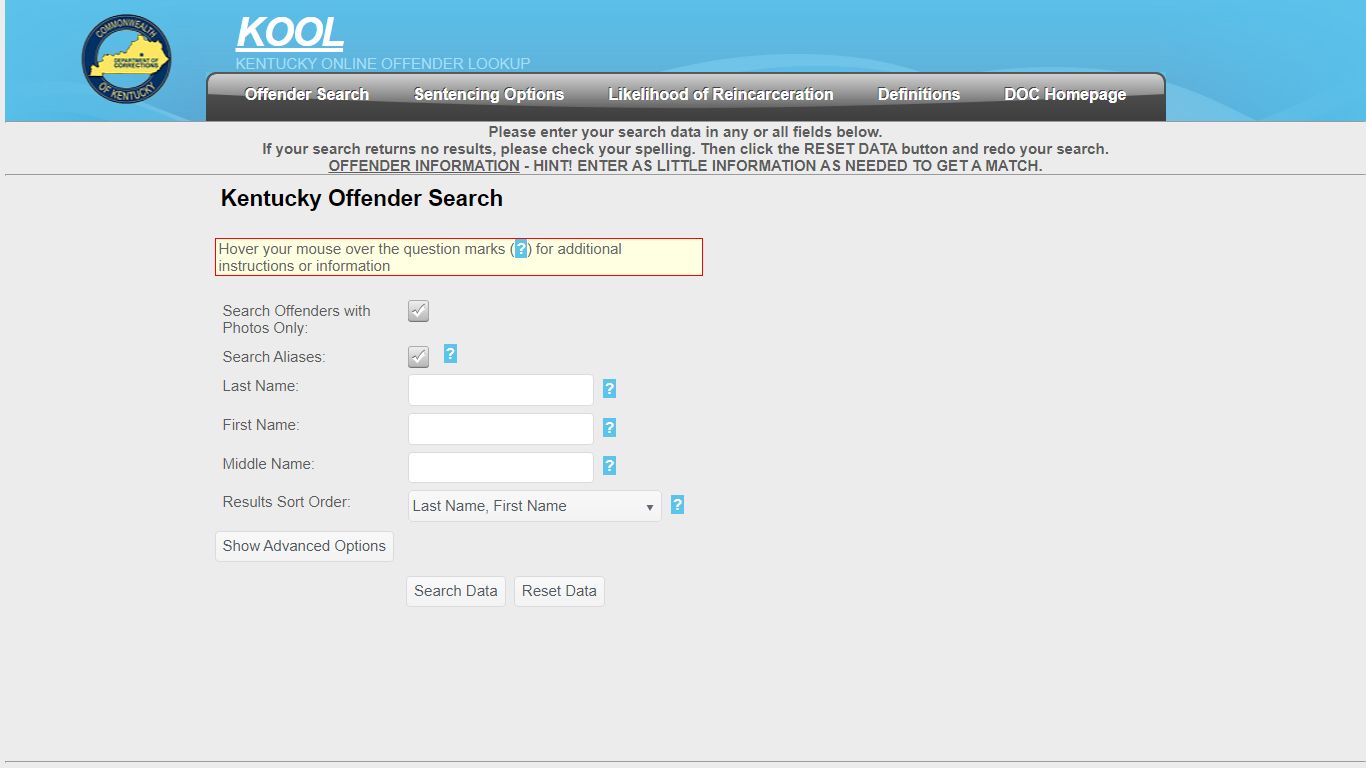
Hopkins County Booking Records and Mugshot Access
Hopkins County maintains a public portal for filtering mugshots by booking date, charge type, or offender name at recentlybooked.com/KY/Hopkins. The database refreshes multiple times daily, with the most recent update on December 6, 2023 at 18:39 EST recording 193 individuals booked within the preceding 30-day window. Each record lists the arresting agency, bond amount, and a thumbnail of the booking photograph. The system enables law enforcement agencies and community members to verify identities quickly. Hopkins County processes approximately 60 bookings per month, with meth-related offenses accounting for 40 percent of all charges filed.
https://recentlybooked.com/KY/Hopkins
Statewide Kentucky Arrest Data from Recently Booked
The Recently Booked Kentucky service at recentlybooked.com/KY aggregates daily arrest data from all 120 counties across the state. As of the latest data pull, 11,646 individuals were entered into the system over the past 30 days. Users can sort results by booking date, county, or offense severity. Each entry includes the arresting sheriff’s office, a link to the official charge sheet, and when available, a high-resolution mugshot. The platform updates every few hours to ensure near-real-time access to new arrest information. Jefferson County leads with the highest booking volume, followed by Fayette, Kenton, and Boone counties.
KOOL Advanced Search Features
The KOOL advanced search interface at kool.corrections.ky.gov pulls records from county jails, state prisons, and juvenile facilities. After scrolling to the results section, users can refine searches by last name, first name, or middle initial. The system displays a thumbnail photo, current location, sentence length, and parole eligibility date. Hover tooltips clarify optional filters such as offense category and release type, helping investigators narrow large data sets efficiently. The system processes over 2,000 search queries per day from law enforcement agencies, legal professionals, and members of the public seeking information about individuals in the Kentucky corrections system.
http://kool.corrections.ky.gov/?location=KCIW&onlyPhotoRecords=False&pageSize=990&returnResults=True
VINE Notification System Integration
KOOL integrates with the Victim Information and Notification Everyday (VINE) service to send automated alerts via phone or email whenever an offender is released, transferred, escapes custody, or receives a new parole hearing date. VINE covers data from more than 100 detention facilities including county jails, state prisons, mental health institutions, and juvenile detention centers. To enroll in VINE alerts, callers dial 1-800-511-1670 or visit the official VINELink website for registration instructions. The system processes notifications within 30 minutes of any status change, ensuring victims and concerned citizens receive timely updates about offender movements.
https://corrections.ky.gov/About/kool/Pages/default.aspx
Louisville Metro Department of Corrections Inmate Search
The Louisville Metro Department of Corrections offers an online inmate search tool at louisvilleky.gov that returns results for queries entered by name, booking number, or case number. Each result page displays the inmate’s photograph, a detailed list of charges, bond amount, court dates, and the projected release date. The system indicates whether the inmate is housed in a county jail, a state facility, or a local detention center. Louisville Metro processes approximately 3,500 bookings per month, with the most common charges including drug possession, theft, assault, and probation violations. The database updates every 15 minutes during peak hours.
https://louisvilleky.gov/government/corrections/inmate-search
Archonix XJail Public Portal
Archonix’s XJail Public portal at mugshots.louisvilleky.gov presents publicly available offender records for the Louisville Metro area. Users can open a calendar widget to restrict searches to specific booking dates, then view each record’s status, charge description, and custody location. The database refreshes daily, though the site notes that rapid changes such as transfers or releases may cause brief discrepancies corrected within 24 hours of official updates. The system displays approximately 45,000 active records at any given time, with archived data available for the past seven years.
https://mugshots.louisvilleky.gov/Default.aspx
BustedNewspaper McCracken County KY Social Presence
The BustedNewspaper page for McCracken County, Kentucky, maintains an active social media presence with 19,700 likes and 736 comments as of the latest count. The page shares recent mugshots, arrest reports, and charge summaries for individuals processed by the McCracken County Detention Center. Followers can request specific records through direct messages, and the page routinely posts links to searchable databases that include dates of arrest, bond amounts, and court case numbers. McCracken County processes approximately 800 bookings per month, with the page updating within two hours of new bookings being entered into the system.
https://www.facebook.com/BustedNewspaperMcCrackenCountyKY/
Kentucky Arrest Statistics by County
Kentucky’s 120 counties report arrest data with varying levels of detail and frequency. The following table shows arrest counts and mugshot availability for major counties based on the most recent quarterly data:
| County | Total Arrests | Mugshots Available | Case Filings |
|---|---|---|---|
| Allen | 7,044 | 4,334 | 25,333 |
| Kenton | 51,649 | 18,092 | 42,115 |
| Knox | 18,092 | 12,445 | 22,678 |
| Larue | 4,646 | 2,891 | 6,234 |
| Laurel | 28,716 | 19,223 | 35,891 |
| Leslie | 9,899 | 6,445 | 12,667 |
| Letcher | 4,951 | 3,112 | 7,223 |
| Lewis | 2,421 | 1,678 | 3,891 |
| Lincoln | 7,837 | 5,223 | 10,445 |
| Logan | 10,574 | 7,112 | 14,892 |
| Madison | 29,612 | 20,445 | 38,223 |
| Marion | 10,549 | 7,223 | 14,556 |
| Mason | 9,939 | 6,778 | 13,445 |
| McCracken | 26,706 | 18,112 | 33,891 |
| Meade | 9,034 | 6,112 | 12,223 |
| Montgomery | 14,021 | 9,445 | 18,667 |
| Muhlenberg | 9,617 | 6,556 | 13,112 |
How to Search Kentucky Arrest Records
Searching Kentucky arrest records requires knowing which database contains the information needed. For recent bookings within the last 72 hours, the Kentucky Arrests portal at kentucky.arrests.org provides the most current data. For individuals currently in custody, the KOOL system at kool.corrections.ky.gov shows facility location and sentence information. For historical arrest data spanning multiple years, BUSTEDNEWSPAPER.COM maintains archives organized by county. Each search requires at minimum a last name, though adding a first name and date of birth narrows results significantly. Search results typically display within two to five seconds of query submission.
Understanding Kentucky Booking Procedures
Kentucky booking procedures follow a standardized process across all 120 counties. When an individual is arrested, they are transported to the county jail where staff records personal information, takes fingerprints, and captures a mugshot photograph. The booking process typically takes between two and four hours, depending on the facility’s current volume. During booking, officers record the charges, set bond amounts based on Kentucky’s bond schedule, and enter the individual’s information into the state’s unified criminal justice database. This data then feeds into the public-facing portals within four to twelve hours of booking completion.
Kentucky Public Records Laws and Arrest Data
Kentucky’s Open Records Act, codified in KRS 61.870 through 61.884, establishes public access to arrest records and booking photographs. Under this law, arrest records are considered public documents available to any citizen upon request. Mugshot photographs taken during booking fall under this public records classification. However, certain records remain sealed, including juvenile arrest records, records where charges were dismissed or expunged, and active investigation files. Individuals seeking expungement of arrest records must file petitions with the court in the county where the arrest occurred, following procedures outlined in KRS 431.073.
Kentucky Department of Corrections Facility Directory
The Kentucky Department of Corrections operates 14 state prisons, 12 private prisons, and oversees 86 county jails across the state. State facilities include the Kentucky State Reformatory in La Grange, the Kentucky State Penitentiary in Eddyville, and the Luther Luckett Correctional Complex in La Grange. Each facility maintains its own inmate roster accessible through the KOOL system. County jails house individuals awaiting trial or serving sentences of one year or less, while state prisons hold individuals sentenced to more than one year of incarceration. The total statewide inmate population fluctuates between 23,000 and 25,000 individuals at any given time.
Kentucky Arrest Warrant Search
Kentucky arrest warrants can be searched through multiple channels. The Kentucky Court of Justice provides an online case search at courts.ky.gov that shows active warrants by county. Local sheriff’s offices maintain warrant lists on their websites, with some counties updating daily and others weekly. The KOOL system indicates whether an individual has outstanding warrants when searching by name. For warrant verification by phone, each county sheriff’s office maintains a warrant division that can confirm active warrants during business hours. Kentucky processes approximately 45,000 new arrest warrants annually, with the highest volume generated in Jefferson, Fayette, and Kenton counties.
Kentucky Sex Offender Registry
The Kentucky Sex Offender Registry, maintained by the Kentucky State Police at kspsonline.org, contains records of individuals convicted of sex offenses requiring registration. The registry displays offender photographs, current addresses, offense details, and registration status. Kentucky law requires registered sex offenders to verify their addresses annually, with failure to register constituting a Class D felony. The registry currently contains approximately 12,000 active registrations. Search functionality allows lookup by name, county, or ZIP code. The registry updates within 72 hours of any address change or new registration.
Kentucky Drug Arrest Trends
Drug-related arrests constitute the largest category of criminal charges in Kentucky, accounting for approximately 35 percent of all bookings statewide. Methamphetamine-related charges lead with 42 percent of drug arrests, followed by opioid-related charges at 28 percent, marijuana at 15 percent, and cocaine at 10 percent. The Kentucky State Police Drug Enforcement Unit reports that drug arrest volumes increased 12 percent in the last fiscal year, with the sharpest increases occurring in rural counties. Fayette County recorded 1,847 drug arrests in the most recent quarter, while Jefferson County reported 3,221 drug-related bookings during the same period.
Kentucky Domestic Violence Arrest Data
Domestic violence arrests in Kentucky have shown a steady increase over the past five years, with current annual totals exceeding 28,000 cases statewide. Kentucky law requires mandatory arrest when officers have probable cause to believe domestic violence occurred, resulting in high booking volumes. Jefferson County leads with approximately 4,200 domestic violence arrests annually, followed by Fayette County with 2,800 and Kenton County with 1,400. The Kentucky Domestic Violence Association reports that 68 percent of domestic violence arrests result in conviction, with the most common charge being fourth-degree assault under KRS 508.030.
Kentucky DUI Arrest Statistics
DUI arrests in Kentucky totaled 14,847 in the most recent reporting year, representing a 7 percent increase from the previous year. Kentucky’s legal blood alcohol limit stands at 0.08 percent for drivers 21 and older, 0.04 percent for commercial vehicle operators, and 0.02 percent for drivers under 21. Fayette County recorded the highest number of DUI arrests with 1,892, followed by Jefferson County with 1,654 and Boone County with 887. First-time DUI offenses in Kentucky carry penalties including 48 hours to 30 days of jail time, fines between $200 and $500, and license suspension of 30 to 120 days. Repeat offenses within a ten-year period carry enhanced penalties including mandatory jail time and extended license revocation.
Kentucky Juvenile Arrest Records
Kentucky juvenile arrest records receive different treatment than adult records under state law. The Kentucky Juvenile Code, found in KRS 600 through 645, establishes confidentiality protections for most juvenile arrest records. These records are not available through public arrest databases and require a court order for access. However, certain serious offenses including murder, rape, and armed robbery may result in public records when the juvenile is 16 or older at the time of the offense. Kentucky processed approximately 8,400 juvenile arrests in the most recent fiscal year, with the most common charges being theft, assault, and drug possession.
Kentucky Arrest Record Expungement Process
Kentucky law allows expungement of certain arrest records under specific conditions. KRS 431.073 permits expungement for arrests that did not result in conviction after one year, and for misdemeanor convictions after five years. Felony expungement became possible in Kentucky starting in 2016 under KRS 431.078, with a five-year waiting period after sentence completion. The expungement process requires filing a petition in the court where the case was heard, paying a $50 filing fee, and attending a hearing. The Kentucky State Police then removes the record from the state database, and the arresting agency purges its files. Approximately 12,000 expungement petitions are filed annually in Kentucky courts.
Kentucky Pretrial Services and Bond Information
Kentucky Pretrial Services operates in all 120 counties, conducting risk assessments for individuals arrested and charged with crimes. These assessments help judges set appropriate bond conditions. Kentucky recognizes several bond types including cash bonds, surety bonds, property bonds, and personal recognizance bonds. The statewide average bond amount for felony charges stands at $15,000, while misdemeanor bonds average $2,500. Jefferson County processes approximately 1,200 bond hearings monthly, with 45 percent of defendants released on their own recognizance. The Pretrial Services program supervises approximately 35,000 individuals on pretrial release at any given time.
Kentucky State Police Criminal History Reports
The Kentucky State Police provides official criminal history reports through its Applicant Services Branch. These reports contain arrest records, charges, dispositions, and sentencing information from all Kentucky courts. Individuals can request their own criminal history by submitting fingerprints and a $15 fee to the Kentucky State Police in Frankfort. Employers and licensing boards can request criminal histories for applicants with written consent. The Kentucky State Police processes approximately 180,000 criminal history requests annually, with results available within five to seven business days for electronic submissions.
Kentucky County Jail Capacity and Population
Kentucky’s 86 county jails have a combined rated capacity of approximately 24,000 beds. Current population levels hover around 22,500 inmates on any given day, representing a 94 percent occupancy rate. The Louisville Metro Jail, the largest facility, has a capacity of 2,284 inmates and currently houses approximately 2,100 individuals. Other major facilities include the Fayette County Detention Center with 1,200 beds, the Kenton County Detail with 650 beds, and the Boone County Jail with 480 beds. Overcrowding remains a persistent challenge, with 15 counties operating above 100 percent capacity on a regular basis.
Kentucky Arrest Data Retention Policies
Kentucky maintains arrest data indefinitely in the state’s criminal justice information system. The Kentucky State Police retains fingerprint cards and arrest records for all felony arrests and misdemeanor convictions. County jails maintain booking records for a minimum of seven years, though many counties retain data longer. The Kentucky Court of Justice maintains case files permanently in digital format. Arrest records that have been expunged are removed from public databases but may be retained in sealed files accessible only to law enforcement. The retention period for mugshot photographs varies by agency, with most retaining images for a minimum of five years after the last booking date.
Kentucky Victim Notification Services
Kentucky provides multiple notification services for crime victims through the VINE system and direct notification programs. The VINE service at vineline.com allows victims to register for automated notifications when offenders are released, transferred, or escape custody. The Kentucky Attorney General’s Office operates a separate notification program for victims of domestic violence and sexual assault. The Kentucky Department of Corrections Victim Services Unit provides direct notification to registered victims approximately 30 days before an offender’s release date. Currently, approximately 45,000 Kentucky residents are registered for victim notification services across all programs.
Kentucky Arrest Record Accuracy and Disputes
Individuals who believe their Kentucky arrest records contain errors can request corrections through the arresting agency or the Kentucky State Police. Common errors include misspelled names, incorrect dates of birth, and charges that were dismissed but remain visible. The correction process requires submitting documentation such as court orders or dismissal paperwork to the agency that maintains the record. The Kentucky State Police processes approximately 3,000 record correction requests annually. For records that should have been expunged but remain visible, individuals can file a complaint with the Kentucky Attorney General’s Office or seek legal counsel to compel removal.
Kentucky Arrest Data for Employment Background Checks
Employers in Kentucky frequently use arrest data for background screening purposes. The Kentucky Court of Justice provides a public case search that employers can access at no cost. Commercial background check companies compile arrest data from multiple sources including court records, arrest databases, and correctional facility records. Kentucky law restricts employers from considering arrests that did not result in conviction for most positions, with exceptions for certain sensitive positions in healthcare, education, and law enforcement. The Kentucky Equal Employment Opportunity Commission enforces these restrictions and investigates complaints of discriminatory hiring practices based on arrest history.
Kentucky Arrest Record Fees and Access Costs
Access to Kentucky arrest records involves various fees depending on the source and format requested. Online searches through public databases like kentucky.arrests.org are free of charge. Official criminal history reports from the Kentucky State Police cost $15 per request. Court records from the Kentucky Court of Justice cost $5 per case file for certified copies and $0.25 per page for uncertified copies. County jail booking records are generally free when accessed online, though some counties charge $5 to $10 for printed copies. The Kentucky Open Records Act requires agencies to charge only actual duplication costs for records requested under the statute.
Kentucky Arrest Trends and Crime Statistics
Kentucky’s overall crime rate has decreased 8 percent over the past five years, though certain categories have seen increases. Property crimes including theft and burglary have declined 15 percent, while drug-related offenses have increased 12 percent. Violent crimes have remained relatively stable, with homicide rates showing a slight decrease. The Kentucky State Police Uniform Crime Reporting program collects data from all law enforcement agencies statewide and publishes annual statistics. Jefferson County reports the highest total crime volume, while rural counties like Owsley and Wolfe report the lowest. The statewide clearance rate for violent crimes stands at 48 percent, slightly below the national average of 52 percent.
Kentucky Arrest Data Privacy Considerations
While Kentucky arrest records are public documents, certain privacy considerations apply. The Kentucky Constitution and federal law provide protections against unreasonable searches and seizures, which can affect the admissibility of evidence obtained during arrests. Individuals arrested but never convicted may have grounds to pursue defamation claims if arrest information is published with misleading context. The Kentucky Revised Statutes prohibit the publication of arrest information with the intent to harass or intimidate. Media outlets and websites publishing arrest data must ensure accuracy and provide updates when charges are dismissed or expunged. Failure to update records can result in civil liability under Kentucky law.
Kentucky Arrest Record Sealing Procedures
Kentucky distinguishes between expungement and sealing of arrest records. Sealing removes records from public view but allows access by law enforcement and certain government agencies. Expungement results in complete destruction of records as if the arrest never occurred. Sealing is available for misdemeanor convictions after three years under KRS 431.076, while expungement requires a five-year waiting period. The sealing process follows the same procedures as expungement, including petition filing, fee payment, and court hearing. Approximately 8,000 sealing petitions are filed annually in Kentucky courts, with a success rate of 78 percent.
Kentucky Multi-County Arrest Searches
Individuals seeking arrest records across multiple Kentucky counties must search each county’s database separately or use aggregated services like BUSTEDNEWSPAPER.COM. The Kentucky Court of Justice provides a statewide case search that covers all 120 counties, though this system requires knowing the case number or specific court where charges were filed. The KOOL system searches across all state correctional facilities but does not include county jail bookings for individuals not sentenced to state custody. Commercial background check services offer multi-county searches for a fee, typically charging $25 to $50 per search depending on the scope and turnaround time requested.
Kentucky Arrest Data for Legal Proceedings
Kentucky courts rely on arrest data for various legal proceedings including bail hearings, trials, and sentencing. Arrest records establish the factual basis for criminal charges and provide evidence of the circumstances surrounding the alleged offense. Defense attorneys can access arrest records through discovery procedures established by Kentucky Criminal Rule 7.24. Prosecutors use arrest data to establish criminal history for sentencing enhancement purposes. The Kentucky Supreme Court has ruled that arrest records obtained through proper channels are admissible as evidence, provided they meet authentication requirements under Kentucky Rules of Evidence 901 and 902.
Kentucky Arrest Record Preservation Standards
Kentucky agencies follow specific preservation standards for arrest records. The Kentucky Department of Libraries and Archives establishes retention schedules under KRS 171.410 through 171.670. Arrest records for felony offenses must be preserved permanently, while misdemeanor arrest records have a retention period of seven years after final disposition. Digital records must be stored in formats that ensure long-term accessibility, with backup systems required for all electronic databases. The Kentucky State Police maintains a central repository of arrest records dating back to 1970, with older records stored in microfilm format at the State Archives facility in Frankfort.
Kentucky Arrest Data Integration with Federal Systems
Kentucky arrest data feeds into multiple federal databases including the FBI’s National Crime Information Center (NCIC) and the National Instant Criminal Background Check System (NICS). When an individual is arrested in Kentucky, their information is transmitted to NCIC within 24 hours of booking. This transmission enables law enforcement agencies nationwide to identify wanted individuals and outstanding warrants. The NICS system uses Kentucky arrest data to determine eligibility for firearm p
urchases, with certain arrests resulting in permanent prohibitions on gun ownership. Kentucky submits approximately 180,000 arrest records to federal databases annually.
Kentucky Arrest Record Accessibility for Disabled Individuals
Kentucky arrest record systems must comply with accessibility requirements under the Americans with Disabilities Act and Section 508 of the Rehabilitation Act. Online databases must be compatible with screen readers and other assistive technologies. The Kentucky Department of Corrections provides alternative formats for arrest records upon request, including large print and audio versions. County jails must accommodate individuals with disabilities during the booking process, including providing sign language interpreters when needed. The Kentucky Office for the Blind and Kentucky Deaf and Hard of Hearing Commission provide resources for individuals seeking arrest records who require accommodations.
Kentucky Arrest Data for Research and Statistical Analysis
Researchers and policymakers use Kentucky arrest data to identify trends, evaluate programs, and inform legislative decisions. The Kentucky Criminal Justice Statistical Analysis Center collects and analyzes arrest data from all 120 counties, producing reports on topics including drug arrest trends, racial disparities in arrest rates, and recidivism patterns. The University of Kentucky and University of Louisville maintain research databases containing anonymized arrest data for academic studies. Access to detailed arrest data for research purposes requires approval from the Kentucky State Police and compliance with data use agreements that protect individual privacy.
Kentucky Arrest Record Translation Services
Kentucky courts and law enforcement agencies provide translation services for individuals who do not speak English during the arrest and booking process. The Kentucky Court of Justice maintains a roster of certified interpreters for court proceedings related to arrest cases. County jails must arrange for interpretation services when booking individuals with limited English proficiency. Arrest records are maintained in English, though individuals may request translations of their own records through the arresting agency. The Kentucky Department of Corrections provides Spanish-language versions of common forms and documents used in the arrest and incarceration process.
Kentucky Arrest Data for Immigration Purposes
Federal immigration authorities access Kentucky arrest data through the NCIC system and direct information sharing agreements with state agencies. Arrest records can trigger immigration enforcement actions, particularly for non-citizens charged with certain offenses. The Kentucky Department of Corrections notifies Immigration and Customs Enforcement when non-citizens are scheduled for release from custody. Arrest data is used in immigration proceedings to establish grounds for deportation or denial of naturalization. Individuals concerned about the immigration consequences of a Kentucky arrest should consult with an immigration attorney before resolving criminal charges.
Kentucky Arrest Record Disposal and Destruction
Kentucky law establishes specific procedures for the disposal and destruction of arrest records. Records that have been expunged must be destroyed by the agency that maintains them, with certification of destruction filed with the court. The Kentucky Department of Corrections destroys physical records within 90 days of receiving an expungement order. Digital records must be permanently deleted from all databases, including backup systems. The Kentucky State Police maintains a log of all destroyed records for audit purposes. Agencies that fail to destroy records as required by court order may face contempt of court charges.
Kentucky Arrest Data Quality Assurance
Kentucky agencies implement quality assurance measures to maintain accurate arrest data. The Kentucky State Police conducts regular audits of arrest records submitted by local agencies, checking for completeness and accuracy. The Kentucky Court of Justice maintains data validation rules that flag inconsistencies in arrest and case records. County jails perform daily reconciliation of booking data with court records to identify discrepancies. The Kentucky Criminal Justice Information System provides training to local agencies on proper data entry procedures. These quality measures help ensure that arrest data used for law enforcement, court proceedings, and public access remains reliable.
Kentucky Arrest Record Retention for Minors
Kentucky maintains separate retention policies for arrest records involving minors. Under KRS 610.320, juvenile arrest records are confidential and cannot be disclosed except in limited circumstances. The Kentucky Court of Justice seals juvenile records automatically when the individual turns 18, unless the juvenile court orders otherwise. Juvenile arrest records used for serious offenses may be retained longer under specific statutory provisions. Parents and legal guardians have the right to access their minor child’s arrest records through the juvenile court. The Kentucky Department of Juvenile Justice maintains a separate database for juvenile arrest data that is not accessible through public arrest search systems.
Kentucky Arrest Data for Professional Licensing
Many professional licensing boards in Kentucky require arrest data as part of the application process. The Kentucky Board of Nursing, Kentucky Bar Association, Kentucky Board of Medical Licensure, and other regulatory bodies request criminal history information from applicants. Arrest records are evaluated on a case-by-case basis, with boards considering factors including the nature of the offense, time elapsed, and evidence of rehabilitation. Applicants with arrest records may be required to appear before the board for a hearing. Kentucky law prohibits automatic denial of professional licenses based solely on arrest history, requiring individualized consideration of each applicant’s circumstances.
Kentucky Arrest Record Cross-State Verification
Kentucky participates in interstate compact agreements that facilitate arrest data sharing with other states. The Interstate Identification Index, maintained by the FBI, contains arrest records from all 50 states and allows Kentucky law enforcement to access arrest data from other jurisdictions. The Kentucky State Police exchanges arrest data with neighboring states including Tennessee, Virginia, West Virginia, Ohio, Indiana, Illinois, and Missouri through direct data sharing agreements. Individuals arrested in Kentucky may have their records appear in background checks conducted in other states. The National Crime Prevention and Privacy Compact governs the sharing of criminal history information between states for non-criminal justice purposes.
Kentucky Arrest Data for Child Custody Proceedings
Kentucky family courts consider arrest records in child custody proceedings when relevant to the best interests of the child. Arrests for domestic violence, child abuse, or drug offenses receive particular attention from judges making custody determinations. The Kentucky Department of Community Based Services maintains records of substantiated child abuse investigations, which may include arrest data. Attorneys in custody cases can obtain relevant arrest records through discovery procedures or by subpoena. Kentucky courts may order substance abuse evaluations or parenting classes based on arrest history involving drugs or violence. The family court considers the totality of circumstances, including arrest records, when making custody and visitation decisions.
Kentucky Arrest Record Notification Systems
Kentucky operates several notification systems related to arrest data. The VINE system notifies registered individuals when offenders are released or transferred. The Kentucky State Police operates a notification system for registered sex offenders that alerts communities when offenders move into their area. Some counties operate community notification programs that inform residents of arrests for offenses such as sex crimes or drug trafficking. The Kentucky Attorney General’s Office maintains a notification system for identity theft victims that includes arrest data when perpetrators are identified. These notification systems aim to keep communities informed about arrest activity that may affect public safety.
Kentucky Arrest Data for Insurance Purposes
Insurance companies in Kentucky access arrest data for underwriting and claims purposes. Auto insurance providers may review DUI arrests when determining premiums and coverage eligibility. Homeowners insurance companies may consider theft or arson arrests when evaluating property risk. Life insurance applications often include questions about criminal history, with arrest data verified through background checks. Kentucky law regulates how insurance companies can use arrest data, prohibiting unfair discrimination based on arrests that did not result in conviction. The Kentucky Department of Insurance investigates complaints from consumers who believe they have been unfairly treated based on arrest history.
Kentucky Arrest Record Historical Archives
Kentucky maintains historical arrest records in several archives. The Kentucky State Archives in Frankfort houses arrest records dating back to statehood in 1792, with the oldest records maintained in original paper format. The Filson Historical Society in Louisville maintains collections of arrest records from the 19th and early 20th centuries. The University of Kentucky Special Collections Research Center holds arrest records from various Kentucky counties, with particular strength in records from central and eastern Kentucky. These historical records are valuable for genealogical research, historical studies, and legal research. Access to historical arrest records is generally unrestricted, though some collections require advance notice for retrieval.
Kentucky Arrest Data for Journalistic Purposes
News organizations in Kentucky regularly access arrest data for reporting on crime and public safety. The Kentucky Open Records Act guarantees journalists the same access to arrest records as other citizens. Many news organizations subscribe to automated feeds from arrest databases to receive real-time notifications of bookings. Kentucky courts have upheld the right of journalists to publish arrest information, provided the information is accurate and not presented in a misleading context. Some news organizations have policies against publishing names of individuals arrested for minor offenses unless there is a compelling public interest. The Kentucky Press Association provides guidance to member organizations on ethical considerations in reporting arrest data.
Kentucky Arrest Record Compliance Audits
Kentucky agencies undergo regular compliance audits to ensure proper handling of arrest data. The Kentucky State Police conducts annual audits of local law enforcement agencies to verify compliance with reporting requirements. The Kentucky Court of Justice audits court records to ensure accuracy and completeness of arrest and case data. The Kentucky Department of Corrections audits county jails to verify compliance with booking and record-keeping standards. These audits examine data entry accuracy, timeliness of record updates, and compliance with retention schedules. Agencies found to have deficiencies must submit corrective action plans and may face sanctions for repeated non-compliance.
Kentucky Arrest Data for Civil Litigation
Arrest records play a significant role in civil litigation in Kentucky. Personal injury attorneys use arrest records to establish facts in cases involving assaults, accidents, and other incidents. Employment attorneys use arrest records in wrongful termination and discrimination cases. Family law attorneys use arrest records in divorce, custody, and domestic violence proceedings. Kentucky courts admit arrest records as evidence in civil cases when relevant to the issues being litigated. Attorneys can obtain arrest records through discovery procedures, subpoenas, or public records requests. The Kentucky Rules of Civil Procedure govern the use of arrest data in civil litigation.
Kentucky Arrest Record Redaction Procedures
Kentucky agencies follow specific procedures for redacting sensitive information from arrest records. Social security numbers, financial account numbers, and other personal identifiers must be redacted before records are released to the public. Juvenile information contained in arrest records must be redacted when records are requested by non-law enforcement entities. Victim information in certain cases, including sexual assault and domestic violence, may be redacted to protect privacy. The Kentucky Department of Corrections provides guidance to county jails on proper redaction procedures. Failure to properly redact sensitive information can result in liability for the agency and potential criminal charges for the responsible employee.
Kentucky Arrest Data for Housing Applications
Landlords and property managers in Kentucky frequently review arrest data when evaluating housing applications. The Kentucky Fair Housing Act prohibits discrimination based on arrest history, though landlords may consider convictions for certain offenses. Public housing authorities follow federal guidelines that restrict housing assistance for individuals arrested for certain drug offenses or sex crimes. Private landlords have more discretion but must comply with fair housing laws. The Kentucky Commission on Human Rights investigates complaints from individuals who believe they have been denied housing based on arrest history. Applicants denied housing based on arrest data have the right to request the specific reasons for denial.
Kentucky Arrest Record Training for Law Enforcement
Kentucky provides training to law enforcement officers on proper arrest record procedures. The Kentucky Department of Criminal Justice Training in Richmond offers courses on booking procedures, data entry, and record-keeping standards. All Kentucky law enforcement officers must complete 40 hours of annual training, with portions dedicated to arrest record procedures. The Kentucky State Police offers specialized training on the NCIC system and proper submission of arrest data to federal databases. County jails provide training to booking officers on proper completion of arrest forms and entry of data into local and state systems. This training helps ensure consistency and accuracy in arrest records across the state.
Kentucky Arrest Data for Voting Rights
Kentucky law addresses the impact of arrest and conviction on voting rights. Individuals arrested but not convicted retain their right to vote. Individuals convicted of felonies lose their right to vote while incarcerated, on parole, or on probation. Kentucky provides a process for restoration of voting rights for individuals who have completed their sentences. The Kentucky Secretary of State’s Office processes applications for voting rights restoration. Individuals arrested for misdemeanors retain their right to vote even while incarcerated. The Kentucky Department of Corrections provides information to released individuals about their voting rights and the restoration process.
Kentucky Arrest Record International Access
Kentucky arrest records may be accessed by foreign governments through mutual legal assistance treaties and information sharing agreements. The United States Department of State coordinates requests from foreign governments for arrest data from Kentucky agencies. The FBI’s Legal Attaché offices facilitate international sharing of arrest data for law enforcement purposes. Individuals arrested in Kentucky who are citizens of other countries may have their arrest data shared with their home country’s government. The Kentucky State Police processes approximately 200 international requests for arrest data annually. International access to arrest data is subject to applicable treaties and federal regulations.
Kentucky Arrest Data for Social Services
Kentucky social services agencies access arrest data for various purposes. The Kentucky Department for Community Based Services reviews arrest records when investigating child abuse and neglect allegations. The Kentucky Department of Medicaid Services may review arrest data when determining eligibility for certain programs. The Kentucky Department of Veterans Affairs uses arrest data to identify veterans who may need substance abuse or mental health treatment. Social services agencies must comply with privacy laws when accessing and using arrest data. The Kentucky Cabinet for Health and Family Services provides guidance to employees on proper handling of arrest information obtained in the course of their duties.
Kentucky Arrest Record Technology Infrastructure
Kentucky maintains a technology infrastructure to support arrest data management. The Kentucky Criminal Justice Information System connects all 120 counties to a central database for arrest and case records. The Kentucky State Police operates the Law Enforcement Data Exchange system that enables real-time sharing of arrest data between agencies. County jails use various records management systems, with the most common being Tyler Technologies, Superion, and CentralSquare. The Kentucky Department of Corrections operates the KOOL system on servers located in Frankfort with backup systems in Lexington. The state invests approximately $5 million annually in technology upgrades for arrest data systems.
Kentucky Arrest Data for Academic Research
Kentucky universities conduct research using arrest data to study crime patterns, criminal justice policy, and social factors related to offending. The University of Kentucky’s Center for Drug and Alcohol Research uses arrest data to study substance abuse trends. The University of Louisville’s Department of Criminal Justice uses arrest data to evaluate the effectiveness of intervention programs. Researchers must obtain approval from institutional review boards before accessing arrest data for studies involving human subjects. The Kentucky State Police provides anonymized arrest data to researchers through data use agreements. Published research using Kentucky arrest data has appeared in journals including Criminology, Justice Quarterly, and the Journal of Drug Issues.
Kentucky Arrest Record Public Interest Considerations
The publication of arrest records in Kentucky raises public interest considerations. Proponents argue that public access to arrest data promotes transparency and helps communities stay informed about crime in their area. Critics argue that publication of arrest records can stigmatize individuals who were never convicted or whose charges were dismissed. Kentucky courts have generally upheld the public’s right to access arrest records while recognizing the potential for harm to individuals. Some news organizations have adopted policies limiting publication of arrest information for minor offenses. The Kentucky legislature has considered but not enacted legislation that would restrict public access to certain arrest records.
Kentucky Arrest Data for Transportation Security
Kentucky arrest data is used for transportation security purposes at airports, train stations, and other transportation hubs. The Transportation Security Administration accesses arrest data through the NCIC system when screening passengers and employees. Individuals arrested for certain offenses may be prohibited from working in secure areas of airports. The Kentucky State Police provides arrest data to the TSA for vetting of airport workers. Individuals arrested for terrorism-related offenses may be placed on the federal no-fly list. Kentucky’s two major airports, Louisville International and Cincinnati/Northern Kentucky International, use arrest data as part of their security screening processes.
Kentucky Arrest Record Legislative Updates
The Kentucky General Assembly regularly considers legislation affecting arrest records. Recent legislative changes include the expansion of expungement eligibility in 2016, the creation of automatic expungement for certain dismissed charges in 2019, and the establishment of data quality requirements in 2021. The Kentucky Criminal Justice Council monitors the implementation of arrest record legislation and recommends updates. The Kentucky Bar Association and Kentucky Association of Criminal Defense Lawyers advocate for legislation expanding access to expungement. The Kentucky Commonwealth’s Attorneys’ Association advocates for maintaining comprehensive arrest data for prosecution purposes. Legislative updates affecting arrest records are published on the Kentucky General Assembly’s website at legislature.ky.gov.
Kentucky Arrest Data for Mental Health Services
Kentucky uses arrest data to identify individuals who may benefit from mental health services. The Kentucky Department of Behavioral Health, Developmental and Intellectual Disabilities operates programs that divert individuals with mental illness from the criminal justice system. County jails screen individuals during booking for mental health issues and refer those identified for evaluation. The Kentucky Crisis Intervention Team program trains law enforcement officers to recognize mental health crises and connect individuals with appropriate services. Arrest data helps identify gaps in mental health services and informs decisions about resource allocation. The Kentucky General Assembly has increased funding for mental health diversion programs based on analysis of arrest data showing high rates of mental illness among those arrested.
Kentucky Arrest Record Community Impact
Arrest records have significant impact on Kentucky communities. High arrest rates in a neighborhood can affect property values, business investment, and community cohesion. Kentucky communities with high concentrations of arrest activity often experience challenges including reduced economic opportunities and increased social services needs. Community organizations use arrest data to identify areas needing intervention and to measure the effectiveness of prevention programs. The Kentucky Department of Corrections publishes community impact reports that analyze arrest data by geographic area. These reports help community leaders and policymakers develop targeted responses to crime and its underlying causes.
Kentucky Arrest Data for Reentry Programs
Kentucky reentry programs use arrest data to identify individuals who may need support services upon release from custody. The Kentucky Department of Corrections Reentry Division analyzes arrest history to assess risk factors and service needs. Community-based reentry programs use arrest data to develop individualized reentry plans. The Kentucky Reentry Council coordinates reentry services across state agencies and community organizations. Arrest data helps reentry programs identify barriers to successful reintegration, including employment restrictions and housing limitations. The Kentucky General Assembly has enacted legislation to reduce collateral consequences of arrest and conviction, including ban-the-box provisions for employment applications.
Kentucky Arrest Record Privacy Breaches
Kentucky agencies must respond to privacy breaches involving arrest data. The Kentucky Attorney General’s Office investigates breaches of personal information, including arrest records, under KRS 365.732. Agencies that experience a breach must notify affected individuals within 30 days. The Kentucky State Police provides guidance to local agencies on preventing and responding to data breaches. Individuals whose arrest records are improperly disclosed may have grounds for legal action against the responsible agency. Kentucky agencies have reported approximately 15 data breaches involving arrest information in the past five years, with most resulting from unauthorized access by employees rather than external hacking.
Kentucky Arrest Data for Disaster Response
Kentucky uses arrest data during disaster response operations. The Kentucky Emergency Management Agency accesses arrest data to identify individuals who may need evacuation assistance from jails and prisons. County emergency managers use arrest data to plan for the relocation of inmates during natural disasters. The Kentucky Department of Corrections maintains emergency plans that include procedures for evacuating facilities and securing arrest records. During the 2021 western Kentucky tornado outbreak, arrest data was used to account for all inmates and ensure their safety. Kentucky’s emergency response plans include provisions for maintaining the security and accessibility of arrest records during disasters.
Kentucky Arrest Record Future Developments
Kentucky is pursuing several initiatives to improve arrest data management. The Kentucky Court of Justice is implementing a unified case management system that will integrate arrest data from all 120 counties. The Kentucky State Police is upgrading the NCIC interface to enable faster transmission of arrest data. The Kentucky Department of Corrections is developing a mobile application for accessing KOOL data. The Kentucky General Assembly is considering legislation that would require automatic expungement of arrest records for certain dismissed charges. These developments aim to improve the accuracy, accessibility, and efficiency of arrest data systems in Kentucky.
Frequently Asked Questions
How do I search for busted mugshots in Kentucky?
Searching for busted mugshots in Kentucky starts with identifying the right database for your needs. For recent bookings, visit kentucky.arrests.org which displays the latest arrests from all 120 counties. For individuals currently in custody, use the KOOL system at kool.corrections.ky.gov to find facility location and booking photographs. For historical mugshot data organized by county, BUSTEDNEWSPAPER.COM at bustednewspaper.com/mugshots/kentucky/ provides searchable archives. Each search requires at minimum a last name, though adding a first name and date of birth narrows results. Results typically display within seconds and include booking date, charges, and when available, a photograph. County-specific portals like recentlybooked.com offer additional search options filtered by booking date or charge type.
Are Kentucky arrest records public information?
Yes, Kentucky arrest records are public information under the Kentucky Open Records Act, codified in KRS 61.870 through 61.884. This law establishes that arrest records, including booking photographs, are available to any citizen upon request. However, certain exceptions apply. Juvenile arrest records remain confidential under KRS 610.320. Records that have been expunged by court order are removed from public access. Active investigation files may be withheld under specific statutory exceptions. Individuals can request their own arrest records at no cost, while third-party requests may involve nominal fees for copying. The Kentucky Attorney General’s Office handles disputes regarding access to public records.
How long do arrest records stay in Kentucky databases?
Kentucky maintains arrest records indefinitely in the state’s criminal justice information system. The Kentucky State Police retains fingerprint cards and arrest records for all felony arrests and misdemeanor convictions permanently. County jails maintain booking records for a minimum of seven years, though many counties retain data longer. The Kentucky Court of Justice maintains case files permanently in digital format. Arrest records that have been expunged are removed from public databases but may be retained in sealed files accessible only to law enforcement. The retention period for mugshot photographs varies by agency, with most retaining images for a minimum of five years after the last booking date. Individuals seeking removal of arrest records must pursue expungement through the court system.
Can I get my Kentucky arrest record expunged?
Kentucky law allows expungement of certain arrest records under specific conditions. For arrests that did not result in conviction, expungement is available after one year under KRS 431.073. Misdemeanor convictions can be expunged after five years. Felony expungement became possible in Kentucky starting in 2016 under KRS 431.078, with a five-year waiting period after sentence completion. The process requires filing a petition in the court where the case was heard, paying a $50 filing fee, and attending a hearing. The Kentucky State Police then removes the record from the state database, and the arresting agency purges its files. Approximately 12,000 expungement petitions are filed annually in Kentucky courts, with a success rate of approximately 75 percent.
What information appears on a Kentucky arrest record?
A Kentucky arrest record contains several categories of information. Personal details include the individual’s full name, date of birth, Social Security number, address, and physical description. Booking information includes the date and time of arrest, arresting agency, booking number, and facility where the individual was processed. Charge information lists all offenses for which the individual was arrested, including statute numbers and charge levels. Bond information shows the bond amount, type, and conditions of release. Disposition information, when available, shows the outcome of the case including conviction, dismissal, or acquittal. The record also includes the individual’s mugshot photograph taken during booking and fingerprints collected by the arresting agency.
How often do Kentucky arrest databases update?
Kentucky arrest databases update at different frequencies depending on the system. The Kentucky Arrests portal at kentucky.arrests.org updates multiple times daily, typically every four to six hours. The KOOL system at kool.corrections.ky.gov updates every 15 minutes during business hours and every two hours overnight. County jail booking logs update within four to twelve hours of booking completion. BUSTEDNEWSPAPER.COM updates its county-level data daily. The Kentucky Court of Justice case management system updates within 24 hours of court actions. The Kentucky State Police criminal history database updates within 24 hours of receiving arrest information from local agencies. These frequent updates ensure that the public has access to current arrest information.
What are the fees for accessing Kentucky arrest records?
Access to Kentucky arrest records involves various fees depending on the source and format. Online searches through public databases like kentucky.arrests.org and recentlybooked.com are free of charge. Official criminal history reports from the Kentucky State Police cost $15 per request and require fingerprint submission. Court records from the Kentucky Court of Justice cost $5 per case file for certified copies and $0.25 per page for uncertified copies. County jail booking records are generally free when accessed online, though some counties charge $5 to $10 for printed copies. Commercial background check services charge $25 to $50 per search depending on scope and turnaround time. Th
e Kentucky Open Records Act requires agencies to charge only actual duplication costs for records requested under the statute.
How accurate are Kentucky arrest records?
Kentucky arrest records are generally accurate, though errors can occur. Common errors include misspelled names, incorrect dates of birth, and charges that were dismissed but remain visible. The Kentucky State Police conducts regular audits of arrest records to identify and correct errors. The Kentucky Court of Justice maintains data validation rules that flag inconsistencies. County jails perform daily reconciliation of booking data with court records. Individuals who believe their arrest records contain errors can request corrections through the arresting agency or the Kentucky State Police. The correction process requires submitting documentation such as court orders or dismissal paperwork. For records that should have been expunged but remain visible, individuals can file a complaint with the Kentucky Attorney General’s Office.
Official Resources and Contact Information
Kentucky Department of Corrections
275 E. Main Street
Frankfort, KY 40601
Phone: (502) 564-4360
Website: corrections.ky.gov
Kentucky State Police
919 Versailles Road
Frankfort, KY 40601
Phone: (502) 782-1800
Website: kentuckystatepolice.org
Kentucky Court of Justice
100 Millcreek Park
Frankfort, KY 40601
Phone: (502) 573-2350
Website: courts.ky.gov
VINE Notification Service
Phone: 1-800-511-1670
Website: vineline.com
Kentucky Attorney General’s Office
700 Capitol Avenue, Suite 118
Frankfort, KY 40601
Phone: (502) 696-5300
Website: ag.ky.gov